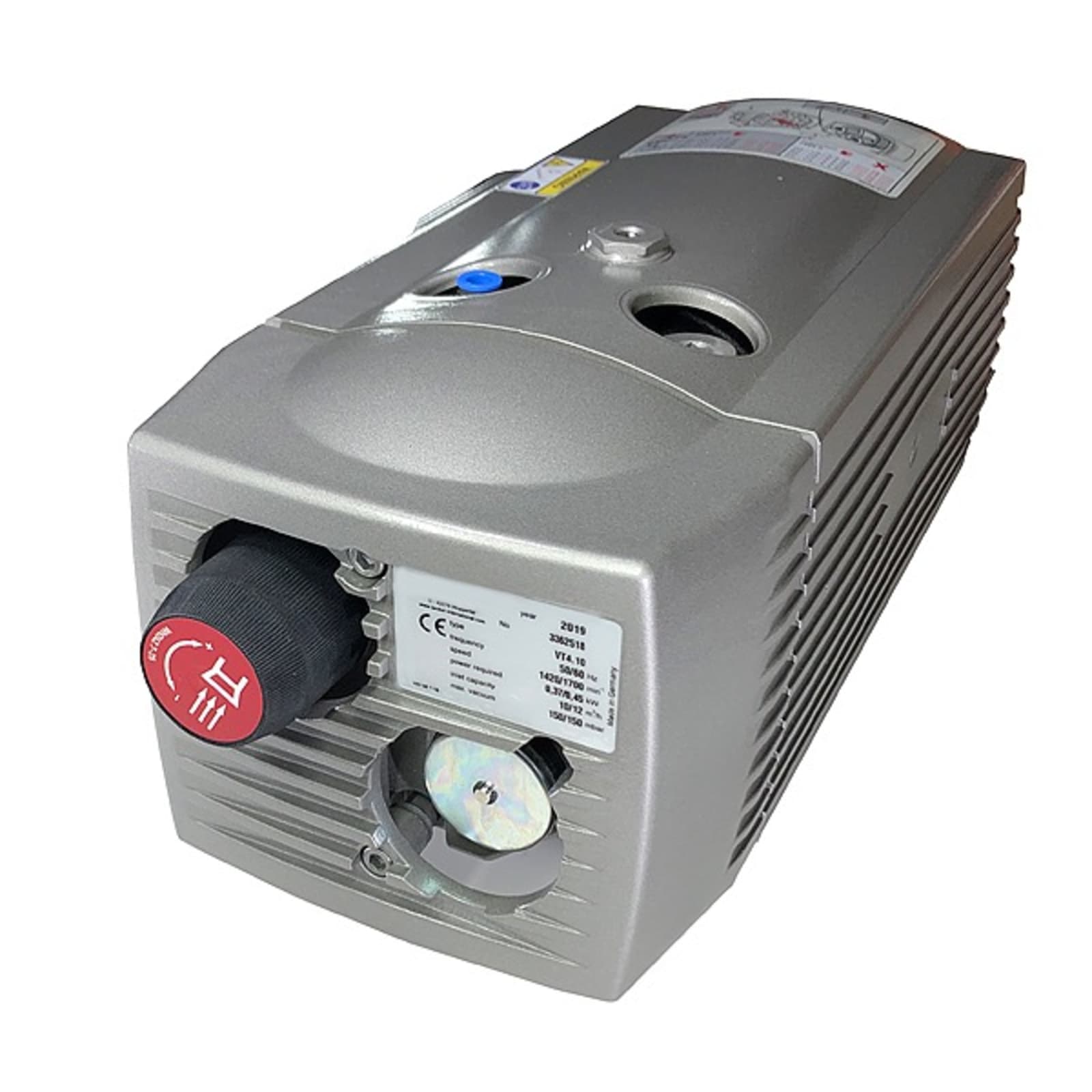
Oil-free industrial rotary vane vacuum pump for very large composite parts, high air volumes and continuous operation.
With a nominal pumping speed of 10 m³/h – approximately 167 l/min – the VT 4.10 provides by far the highest air-handling capacity in this R&G vacuum pump range. It is particularly suitable for large moulds and extensive vacuum bagging systems in aircraft construction, boat building and industrial composite manufacturing.
The rotary vane vacuum pump VT 4.10 is a dry-running pump for applications where large volumes of air must be removed quickly. With a nominal pumping speed of 10 m³/h, it moves approximately three times as much air as the P3 and is therefore particularly suitable for very large moulds, vacuum bags and extensive hose systems.
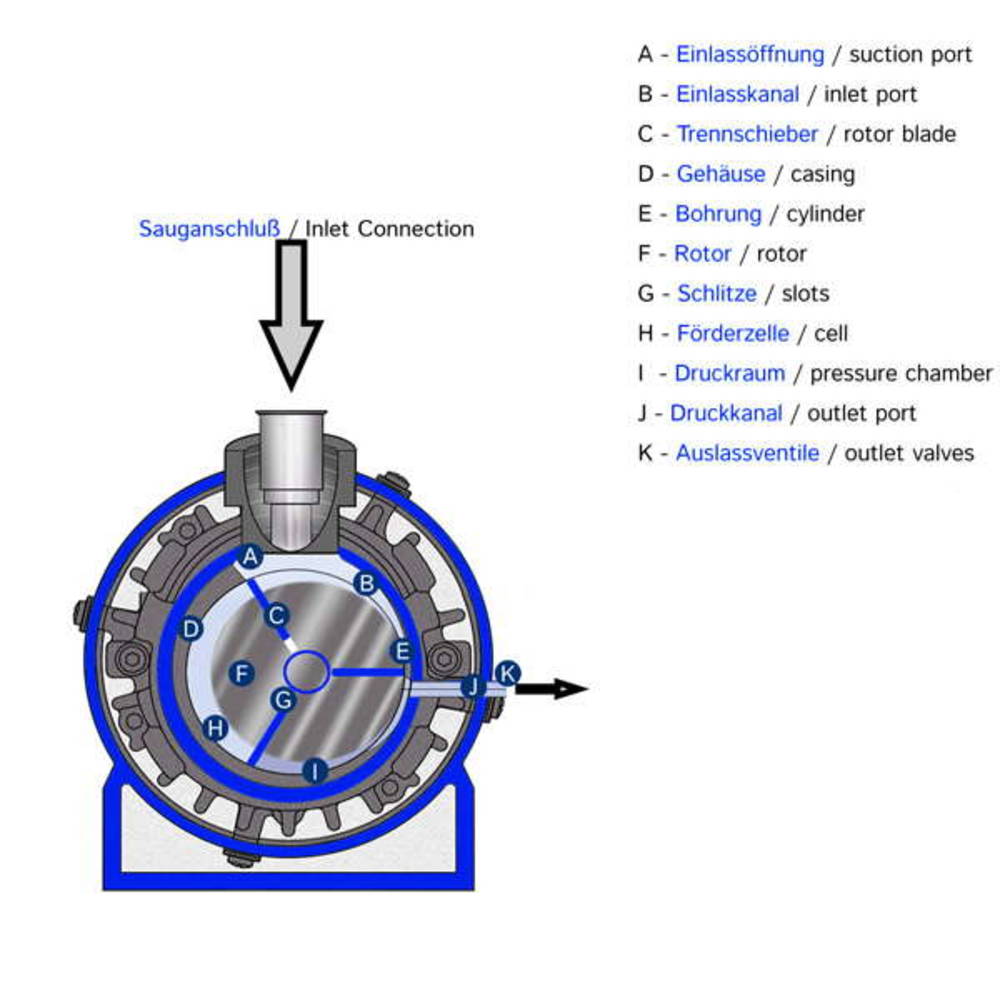
Unlike the diaphragm pumps, the VT 4.10 operates on the dry-running rotary vane principle. Self-lubricating vanes allow completely oil-free operation. No oil changes are required, reducing maintenance compared with oil-lubricated rotary vane pumps.
The ultimate vacuum is 150 mbar absolute. The VT 4.10 therefore does not achieve as low an absolute pressure as the P1-N, P2-N and P3 at 100 mbar absolute or the P3-SPECIAL at 13 mbar absolute. Its key advantage is its substantially higher pumping speed. With large composite parts, rapid evacuation of the enclosed air volume is often more important than achieving the lowest possible ultimate pressure.
Which Vacuum Pump Is Right for My Application?
P1-N
6 l/min · 100 mbar abs.
Small composite parts, model making and smaller vacuum bagging applications
P2-N
30 l/min · 100 mbar abs.
General-purpose vacuum bagging and larger moulds
P3
55 l/min · 100 mbar abs.
Large composite parts and high pumping capacity
P3-SPECIAL
30 l/min · 13 mbar abs.
Resin infusion and applications requiring a lower absolute pressure
VT 4.10
10 m³/h (approx. 167 l/min) · 150 mbar abs.
Very large parts, high air-handling capacity and continuous industrial operation
Selection guide: The VT 4.10 is the preferred choice where very large vacuum bagging systems require high pumping speed and rapid evacuation. The diaphragm pumps offer advantages where a lower ultimate pressure is required; within the range, the P3-SPECIAL is specifically designed for applications requiring the lowest absolute pressure.
Equipment and Practical Benefits
- Very high nominal pumping speed of 10 m³/h or approx. 167 l/min
- Dry-running, completely oil-free rotary vane technology
- Designed for continuous industrial operation
- Self-lubricating vanes – no oil changes required
- Integrated inlet filter – easy to inspect and clean
- Vacuum regulator for setting the working vacuum
- Exhaust silencer for reduced noise
- Robust direct-drive design
- IP 54 protection rating
Technical Data
| Nominal pumping speed at 50 Hz | 10 m³/h (approx. 167 l/min) |
| Ultimate vacuum | 150 mbar absolute |
| Rated motor power at 50 Hz | 0.37 kW |
| Protection rating | IP 54 |
| Sound pressure level at 50 Hz | 60 dB(A) |
| Permissible gas and ambient temperature | +5 to +45 °C |
| Weight incl. motor | 16 kg |
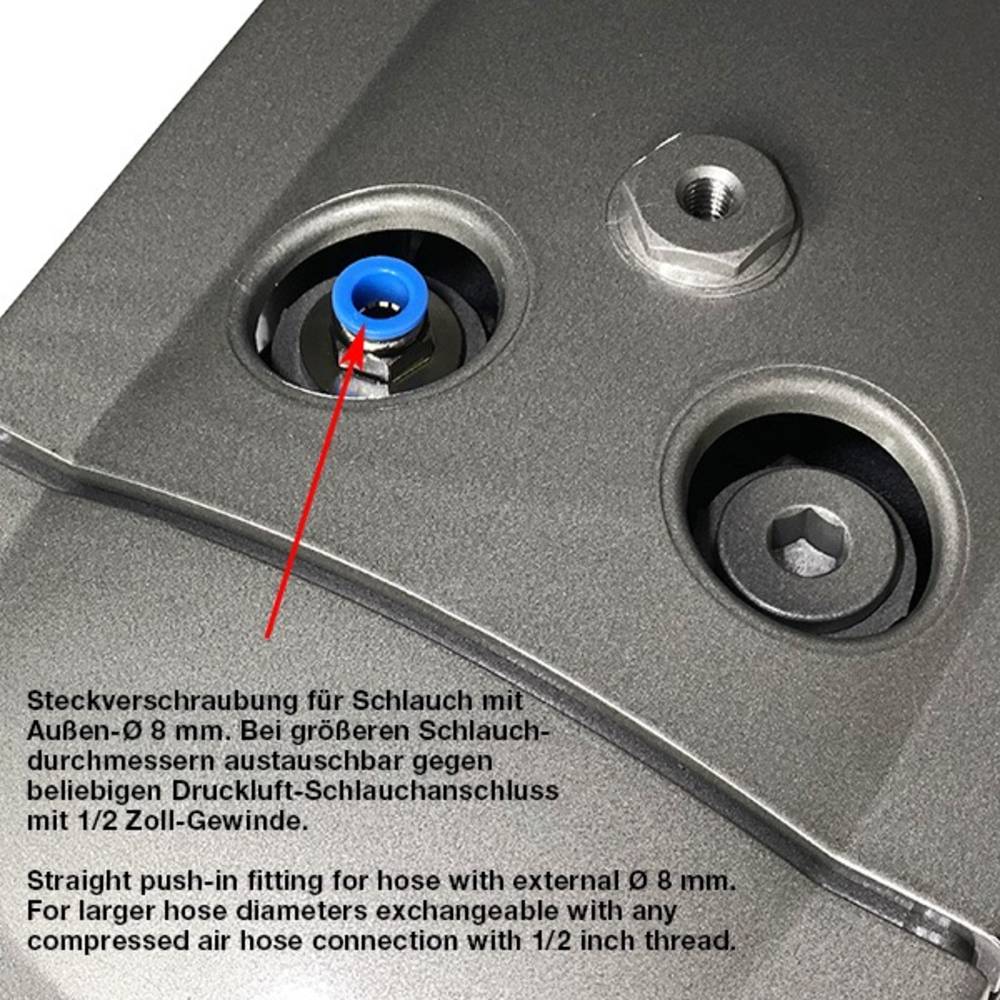
The R&G version is supplied ready for operation with inlet filter, exhaust silencer, vacuum regulator and push-in fitting for tubing with 8 mm outside diameter.
Practical note: With very large moulds, pumping speed is particularly important during the initial evacuation phase. The high air-handling capacity of the VT 4.10 considerably reduces the time required to reach the working vacuum and also provides additional reserve for extensive hose systems and minor unavoidable leaks.
Maintenance: The dry-running, oil-free design keeps maintenance requirements low; in particular, no oil changes are required. The integrated inlet filter should be inspected and cleaned regularly depending on the operating conditions. Depending on the level of contamination in the intake air, the manufacturer recommends an interval of 40 to 200 operating hours. If cleaning is no longer sufficient, the filter cartridge can be replaced. The matching filter cartridge, item no. 3901031-FP1, is available as a spare part. The dry-running vanes are wearing parts and should also be inspected at the intervals specified in the maintenance instructions. Further information and maintenance intervals can be found in the operating instructions.